
Planets in a Box
Próximamente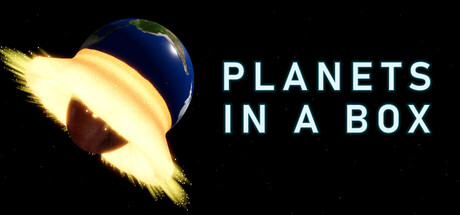


About the game
Haz chocar planetas en un simulador de física en tiempo real. Observa cómo un mundo del tamaño de Marte impacta contra la joven Tierra, los escombros se extienden hasta formar un disco y nace una luna nueva, mientras las mareas estiran los mundos y aceleran su rotación. Hasta 4 millones de partículas en tu GPU. Graba los datos sin procesar de la simulación y reprodúcela desde cualquier ángulo y a cualquier velocidad.
Descripción original de Steam
Crash planets into each other and watch what happens.
Planets in a Box is a real-time simulator of planetary collisions. Every planet is made of thousands to millions of particles of rock and iron that pull on each other with gravity, collide, heat up and splash. Watch a young Earth get hit by a Mars-sized body, see molten debris spread into a disk and a new moon gather in orbit.
Planets in a Box is made for exploration and learning. The physics is simplified to run in real time and is not a research tool; results depend on the number of particles and the model assumptions.
No ads, no account, no microtransactions. Works offline.
Planets in a Box is a real-time simulator of planetary collisions. Every planet is made of thousands to millions of particles of rock and iron that pull on each other with gravity, collide, heat up and splash. Watch a young Earth get hit by a Mars-sized body, see molten debris spread into a disk and a new moon gather in orbit.
Recreate the birth of the Moon
Start with the classic giant-impact scenario: a Mars-sized planet strikes the early Earth at an angle. Follow the impact, the glowing debris and the disk that forms around the planet afterwards.Try your own collisions
Choose a grazing hit-and-run, a dead-centre head-on impact, or a cold, rotating dust cloud collapsing into a planet with clumps in orbit. Change the masses, impact angle, speed, core size and spin before you start.Watch tidal forces at work
Gravity acts on every particle, so tides come for free. Send a planet on a close flyby and watch it stretch into an egg and leave spinning. Put a moon in a close orbit and see it turn one face to its planet, or watch a fast-spinning planet push its moon outward. Bodies that come too close are torn apart into streams of debris.Build your own system
Start from empty space and add planets, the Moon or custom bodies. Put them in orbit, shoot a body at a planet, or select any clump and drag arrows to change its velocity and spin.Look inside
Cut the planets open with a section plane to see the iron core and the mantle. Colour the material by type, temperature or density, or show realistic planet textures. Select any clump to see its mass, speed and spin.Record and replay
Record the full simulation data, every particle in every frame, even for runs with millions of particles. Afterwards, replay it from any angle at any speed: fly the camera around the impact, slow down the moment of contact or race through the hours of debris settling into a moon. Export the replay as a video up to 4K, or save high-resolution pictures.Control time
Pause, rewind the last moments, speed up or slow down the simulation. Choose anywhere from a few thousand to two million particles to balance detail and speed.How it works
Planets in a Box uses smoothed-particle hydrodynamics (SPH) with self-gravity, running entirely on your graphics card. Rock and iron follow simplified equations of state, so planets compress, heat up and flow.Planets in a Box is made for exploration and learning. The physics is simplified to run in real time and is not a research tool; results depend on the number of particles and the model assumptions.
No ads, no account, no microtransactions. Works offline.
Información sobre la demo y el lanzamiento
Los datos de la comprobación actual no confirman ninguna demo. Esto no significa que el juego nunca haya tenido una; consulta su página de Steam para conocer la disponibilidad actual.
Demo de Steam, prueba de juego y acceso anticipado: ¿cuál es la diferencia?
Información e imágenes: Steam · Última comprobación UTC