
Antique Dealer
Demo available


About the game
Antique Dealer is a card collecting and strategy game with 600+ antique cards from ten Chinese dynasties. Leave it running and a beautiful new card arrives every half hour. For a challenge, play the built-in card game of genuine and fake cards, and outplay rival dealers with knowledge and strategy.
Original Steam description

In Antique Dealer, you can collect a variety of distinctive antique cards and play strategic card matches.
Collect
The game holds 600 antique cards from ten Chinese dynasties, from the Xia to the Ming, each with six quality levels.
Leave the game running and a new card arrives every half hour, quietly keeping you company.
The collection can shrink to a single small card in a corner of your desktop, so it never gets in the way.
Every card you collect goes on display in your Antique Codex, sorted by dynasty and quality, so you can browse it any time.
Combine
Drag a spare card onto another spare card of the same dynasty and quality to combine them.
When combining Quality I–V cards, you can choose a card of the same dynasty one quality level higher as your target, with a chance to receive a higher-quality card from a random dynasty instead.
Quality VI cards let you choose a card of any quality from the same dynasty as your target.
Play
When you want a challenge, play the built-in card game and outplay rival dealers with what you know about the cards and a sound strategy.
The Book of Changes says: "When it is time to stop, stop; when it is time to act, act. When movement and stillness each come at the proper time, the way is bright."
For an antique dealer, timing is everything. The largest collection does not make you the winner, nor does one profitable deal. When the dust settles, the dealer holding the most silver wins.

Every antique card has a dynasty, a quality rating and a hidden truth: genuine or fake.
Some cards give themselves away, because their dynasty, name and picture don't match.
A genuine card can bring handsome profits, and a fake one is not necessarily worthless.
You can swallow the loss, take your chances on a buyer who does not know better, expose a fake to drive down its dynasty's market, or bluff a rival into taking it off your hands.
The choice is yours.
Each dynasty has its own independent market level.
A card's market value depends on its quality and its dynasty's current market level. Sales, showcases and exposed fakes, in turn, can push that level up or down.
When a dynasty's market reaches its ceiling, its market is sealed, and all cards from that dynasty are confiscated. Once three dynasties have been sealed, the game ends immediately.

Each game consists of multiple rounds, up to a maximum of 15.
Every round has five distinct phases.
The Five Phases of a Round

As night falls and old wares fill the stalls, you come here to stock your shop.
Every Hidden Market merchant has a distinct temperament and their own rules.
Some sell everything at half price; others offer that deal only on the second item. Some move stock fast, selling only in bulk; others let you take a close look before you buy. Some find all manner of excuses to charge you extra; others specialize in buying back second-hand cards from one dynasty.
Each game brings a different mix of merchants. Cheap does not always mean a bargain, and expensive does not always mean a trap. Study the wares, the merchants and your rivals' choices before deciding where to spend your silver.

Objects gathered from across the realm by the authorities are up for auction today. With the right connections, your own wares can find their way into the catalog—and you can get an early look at what is waiting in the storeroom.
Before bidding begins, you can pay to inspect lots in private, or slip a card of your own into the sale.
Once the auction opens, dealers take turns bidding or dropping out. The last one standing pays and takes the card.
When you enter your own card, only you know whether you are selling a treasure or setting a trap. (Though, let's be honest: everyone knows it's a trap.)

Put a card you have confirmed as genuine on display for everyone to see: your shop's showpiece.
Your showpiece can change the turn order, and a high-quality card may let you act first in the dealings that follow.
A showpiece also raises the market level for its dynasty. As it takes center stage, the market for that dynasty rises with it.
Your showpiece cannot be sold until you take it off display.
Your showpiece is not there to tempt a buyer, but to make those who know its worth think twice before underestimating you.

Choose cards to put on your stall, pay the stall fee, and wait for customers to come calling.
Better stall positions cost more, but customers see—and buy from—them first.
Foot Traffic determines which cards can sell. If foot traffic is too low, you can also spend silver on a sales pitch to attract buyers with deeper pockets.
Knowledgeable customers can tell genuine from fake. Genuine cards sell at market value, while fakes are exposed, earning you nothing and driving down their dynasty's market level. But if the buyer does not know better, a fake card can sell at market value too.
You can also admit that a card of yours is fake, giving up a potential sale to drive down that dynasty's market.

Cards that fail to sell during the Open Market remain on their stalls.
You can make a take-it-or-leave-it offer for another dealer's unsold card;
or wait a little longer and then pick up cards that still have not sold for half their market value.

With 30 Hidden Market merchants, over 600 antique cards both genuine and fake, shifting foot traffic and market levels, and rival dealers scheming at every turn, each game is full of surprises and the outcome is never certain.
Other dealers will vie with you for auction lots, bid up prices, hide information and manipulate the market. When you are most desperate for silver, they may even take a card off your hands at a price you find hard to refuse.
You might lead from the very first round, then fall behind after buying one fake after another. You might also sit on unsold stock for round after round, then make one decisive sale before the market hits its ceiling and turn the entire game around.
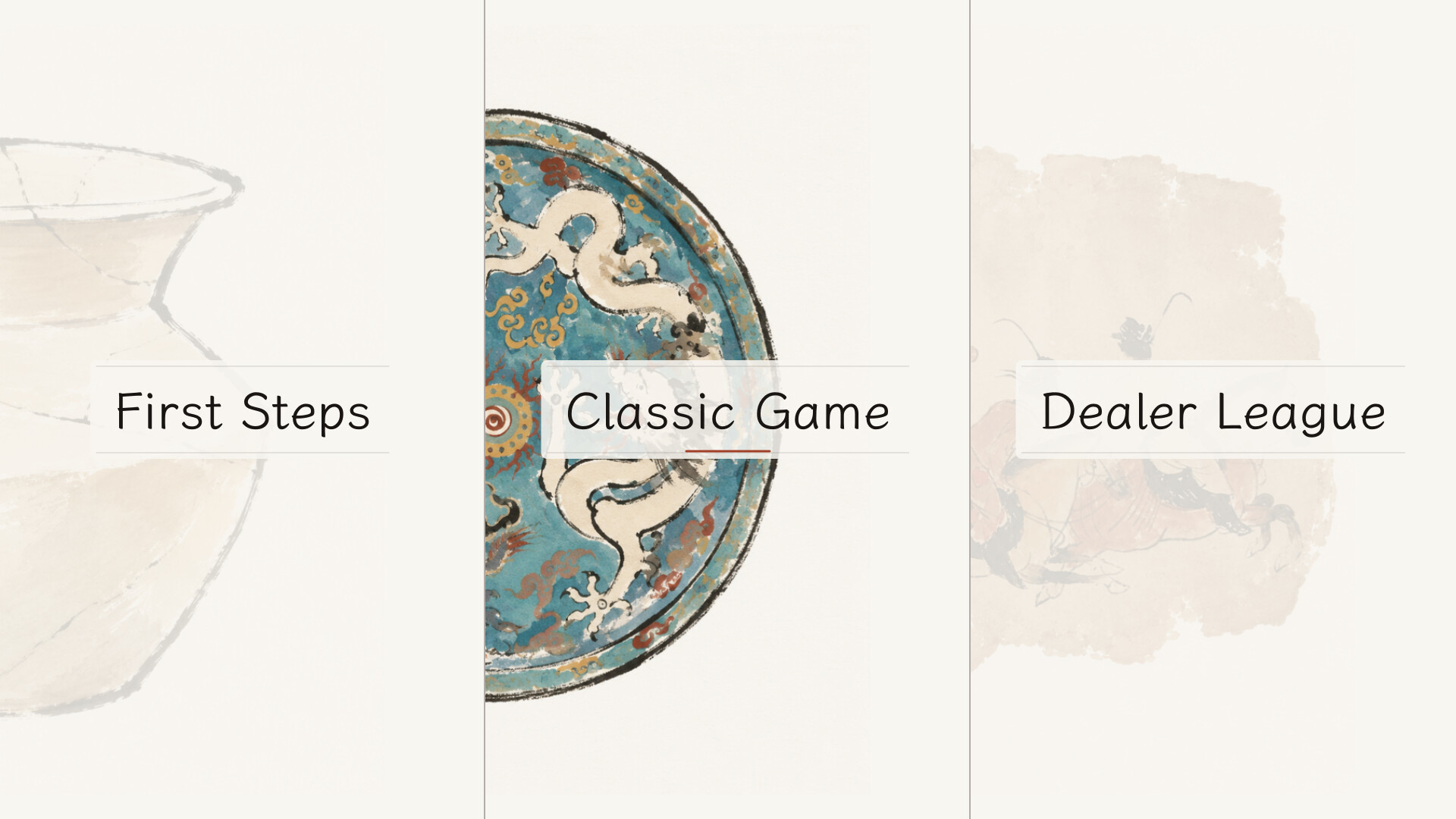
First Steps: Follow a detailed tutorial and learn the rules of the trade as you buy and sell.
Classic Game: Choose your difficulty and test your wits against three other dealers.
Dealer League: Compete in a tournament of a hundred shops, advancing through four-player matches, breaking through round after round to vie for the title of champion.

You and 99 NPC-run shops make up this world of dealers. Every dealer has a history and a reputation, along with distinct trading preferences and abilities. If one of them makes you lose your cool, you can replace that NPC at any time.
Your opponents use underlying strategies or trained reinforcement-learning AI models, weighing potential profits, risks and timing based on the information they have. You will meet shrewd veterans who calculate every move, and rivals whose decisions leave you guessing.
I have one non-negotiable rule for the computer opponents: no cheating. They do not get to see a card's authenticity before the rules allow it. They do not secretly change the odds or conjure extra silver out of thin air. Their calculations and decisions draw only on public information and their own inspection results, under the same rules you play by. They may guess right or wrong. They may set a trap—or fall into yours.
I want the outcome to come down to information, judgment, nerve, calculation and a little luck—not a system quietly taking sides.
Computer opponents can still make poor decisions, and their unconventional moves may leave you scratching your head. That, too, is part of the game.

Disclaimer
The trading scenarios and rules in this game are designed for gameplay and entertainment only. The antique cards are virtual items designed from elements of cultural relics, and the gameplay, items and values shown in the game do not represent anything in the real world. Nothing in the game is real-world advice on antiquities appraisal, trading or investment. Please comply with the laws and regulations applicable to collecting and trading in your jurisdiction.
Demo and release information
A Steam demo was found at the latest check. Confirm it is still available in your region on Steam before downloading.
Steam demo, playtest and Early Access: what is the difference?
Information & artwork: Steam · Last checked UTC