
Gridiron Football GM
近日発売
About the game
アメリカンフットボール球団のフロントを運営しよう。数十年にわたる王朝を築け。複数シーズンにわたるドラフト、フリーエージェント、トレード、サラリーキャップに加え、毎回のスナップ前にプレーを指示。実際のプロフットボールの統計に基づいて調整されています。シングルプレイヤー。マイクロトランザクションなし。
Steamの原文説明
Have you ever dreamed of being a head coach and leading your football team to glory? Draft, build your roster, set the game plan and call the plays your way, all toward the ultimate goal: building your own dynasty.
Gridiron Football GM is a deep, single-player pro football management sim with its own simulated college league. You run one team in a fictional 32-team league as head coach and GM, while 130 college programs play a full season alongside yours and produce nearly all of your draft prospects.
Game day and play calling
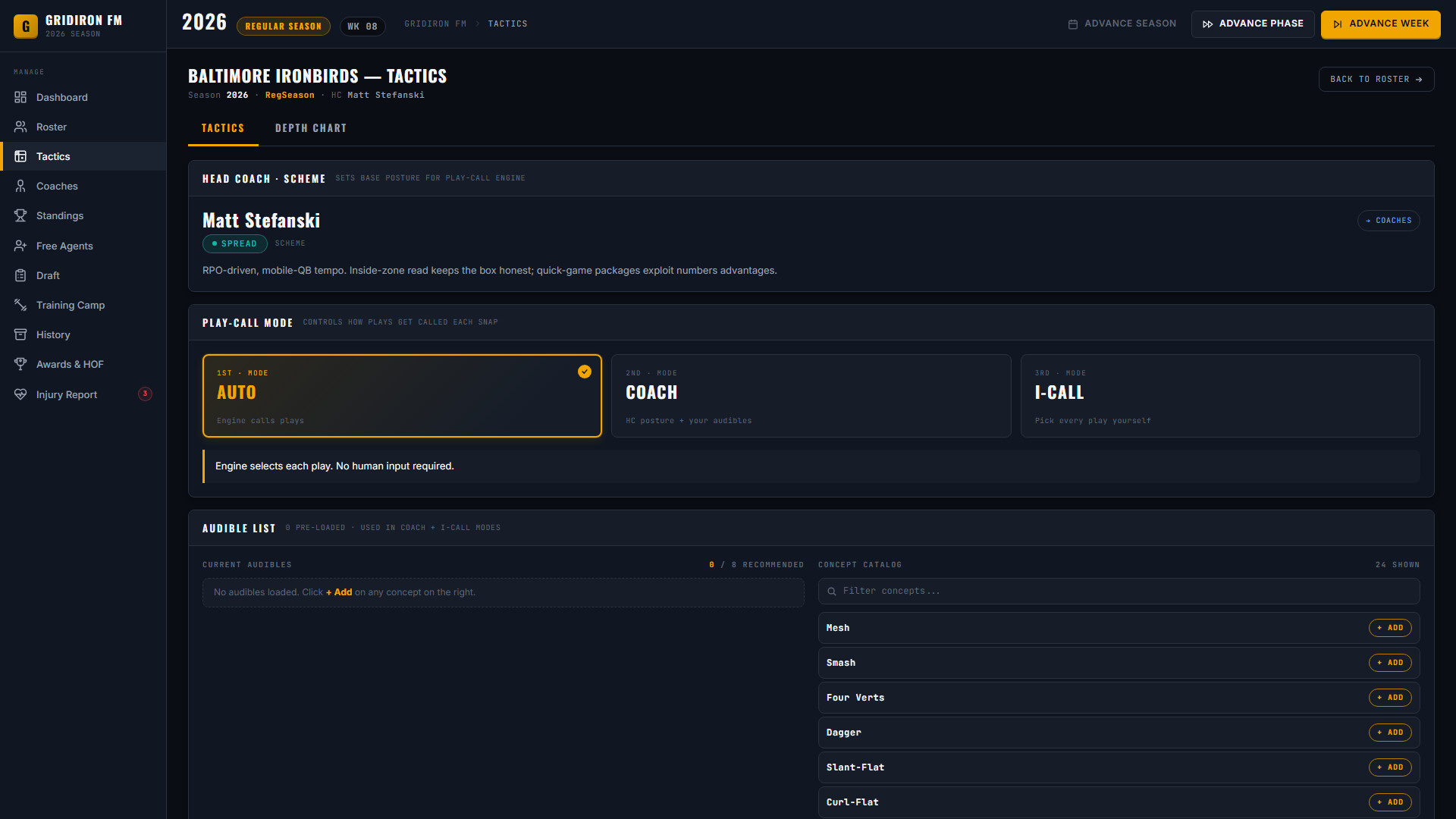
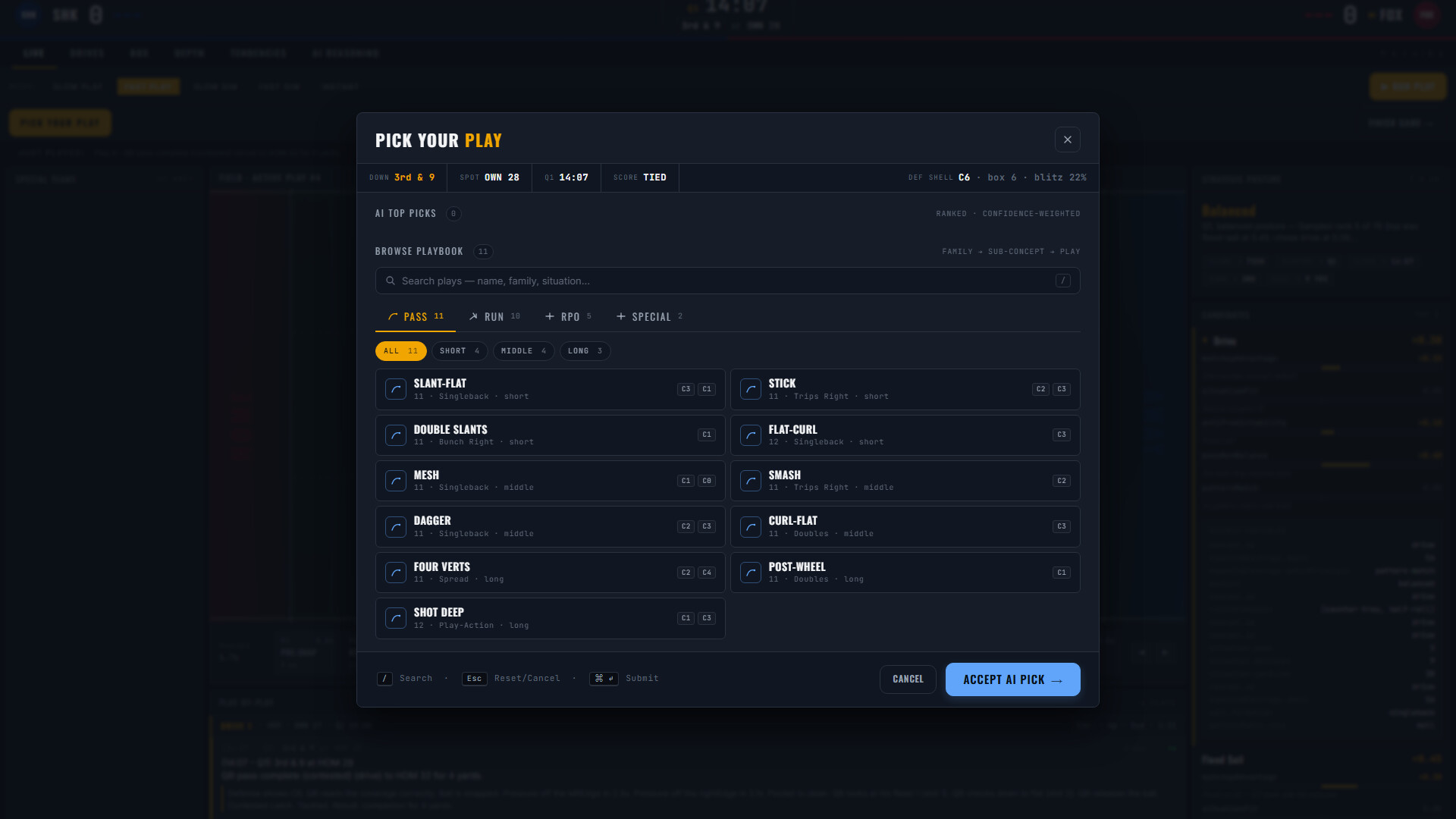
Three coaching modes, chosen separately for offense and defense. In "I Call" mode you pick the play on offense and the front, coverage and pressure on defense. In "Coach" mode you pick the play family on offense (inside run, quick pass, deep shot and more) and the coverage on defense, and your coordinator picks the rest. In "Auto" mode your coordinators call every snap.
The playbook has 18 plays (11 passes and 7 runs) across 6 offensive formations. On defense you pick from 4 fronts, 5 coverage shells and 4 pressure calls, ranging from the base rush to a blitz with two extra rushers.
"Auto" and "Coach" can stop and hand you the big decisions: fourth downs (go for it, punt or kick a field goal) and the choice between an extra point and a two-point try. "Auto" can also stop in the two-minute drill and in overtime and let you pick your offense's plays yourself. You choose in Settings which of these stop the game.
On a fourth down or after a touchdown, you see your win probability for each option, with your coordinator's suggestion marked. When he makes a fourth-down or two-point call himself, the play log records his reason and the win probability of all the options.
You can call timeouts. With your offense in "Coach" or "I Call", you can also kneel or spike late in a half or late in overtime, and try a field goal as time runs out. With your offense in "I Call", you also decide on onside kicks when the rules allow one.
The field is shown in 2D from above. The 22 player dots move through each play in a short animation and the ball's path is traced. The field marks the line of scrimmage and the line to gain, with a drive chart and play-by-play text beside it.
You don't have to watch every snap. Skip ahead to the next play, the end of the drive, quarter or half, the two-minute warning or your next decision, and your coordinators call the snaps in between. The stops you set in Settings still apply. You can also set the playback speed from half speed to instant, or sim the rest of the game.
A live box score, a win probability chart, game grades for the players, and halftime and post-game reports.
Penalties, injuries and fatigue are simulated, and the injury report lists injured players with their status and a range for their return.
You can rewatch finished pro and college games from the current season, including your own, on the same 2D field.
The game saves after every snap, so you can stop in the middle of a game and pick it up at the same snap later.
Game plan and practice
A weekly game plan. Start from one of six presets, such as "Ball control" or "Attack downfield", then lean toward the run or the pass and set how aggressive to be on fourth down. Your offensive coordinator follows the plan when he calls the plays and makes the fourth-down calls.
Set practice for each position group at one of four levels, from "Full" to "Week off". Harder practice brings more growth, more fatigue and a higher injury risk.
Each week you also pick one offensive practice focus (run game, quick passing or downfield passing) and one defensive focus (run or pass defense). Both give your players a small edge on those plays in the next game.
Choose a rotation for running backs, receivers, tight ends, both lines, linebackers and the secondary, for example a bell-cow back or a committee at running back. It decides when a tired starter sits and when he comes back.
Building the roster
The salary cap starts at $255.4 million and grows 6% a year. Contracts run up to seven years, with yearly salaries, signing bonuses spread over up to five years, guaranteed money and dead money.
Before you cut a player or restructure his contract, you see what the move does to your cap.
Re-sign your own players, use the franchise or transition tag, and tender restricted free agents.
Free agency runs in waves, three by default. A free agent scores your offer out of 100 and gives his two main reasons, such as "Wants more guaranteed" or "Worried about playing time". You see roughly how far behind the best offer you are, but not which team made it.
Trades can include players and draft picks. When a computer team turns a deal down, it says why, and the "Make it work" button asks it what it would take.
Computer teams send you trade offers and make trades with each other until the trade deadline.
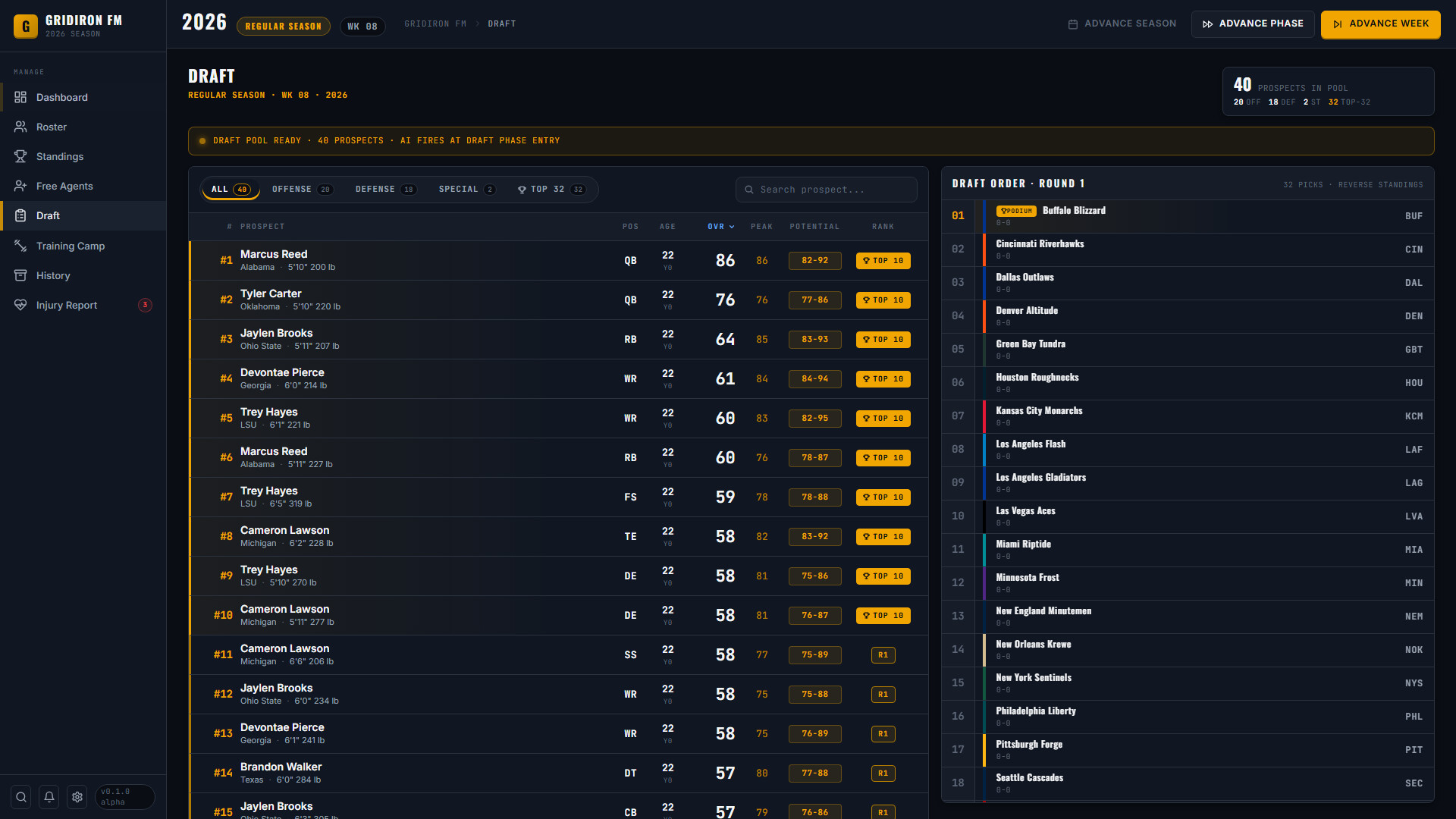
A seven-round draft. Trade picks, take calls from teams that want to move up while you are on the clock, and sign undrafted free agents once the draft is over. Drafted players sign four-year rookie deals on a pay scale set by where they were picked.
Offseason rosters hold up to 90 players, and by default you cut down to 53 before the season, with up to 16 more on the practice squad. Set the depth chart yourself or let the game fill it.
All transactions are logged. Cuts, trades, tags and similar moves can be undone until you advance the calendar, and you can go back to any of your three previous autosaves.
The college league and your prospects
The college programs play in 10 conferences, with a 12-game regular season and college rules, including overtime where each team gets a possession from the 25-yard line.
The college season has a weekly Top 25 poll, a committee ranking and a power ranking, conference title games, up to 35 bowl games and a 12-team playoff.
Six college awards (player of the year, best quarterback, running back, receiver and defensive player, and best freshman), plus all-league and all-conference teams. Each award shows how its finalists were scored, stat category by stat category.
You don't coach a college team. Programs sign their high-school classes on their own, and players redshirt, transfer and declare early for the draft.
Until a prospect is drafted, you see his college stats and awards, game-by-game lines from his last college season, the public consensus rank and an estimated letter-grade range for his overall, but not his true ratings or his potential. His true overall sometimes falls outside that range. Once he is drafted, you see his true ratings and a grade for his potential, and his college career stays on his player page.
By default, four college warm-up seasons are simulated before your career starts, so your first draft class already has college careers behind it.
Simulation, stats and the reasons behind results
All pro and college games, including the ones you don't coach, are simulated play by play the same way as yours.
Each play in the play log has a "Why" card. When a matchup decided the play, the card names the players, for example which receiver beat which defender or which pass rusher got to the quarterback. It also lists what tilted the play, such as home field, weather, fatigue, practice or a play called too often, and by how much.
Changes to a player's ratings are logged with their cause, such as heavy playing time or a rough offseason.
A game-day variance setting ("Steady", "Standard" or "Wild") sets how much a team's form swings from game to game and how much the gain on a single play can vary. The Settings screen shows how often the better team won under each one, measured over 12,000 simulated games per setting. Nothing is scripted, and there is no momentum system.
Two difficulty settings can be changed at any time: a game-day edge that makes your team execute a little better or worse on the field, and a trade margin that raises or lowers the value computer teams ask for in trades with you.
Season stats, snap counts included, and league leaders for both leagues. The leader boards include passer rating, yards per carry and other rate stats.
Players have season-by-season career lines, and pro players also have game-by-game logs of their grades, though not yet of their stats.
Your league, seasons and history
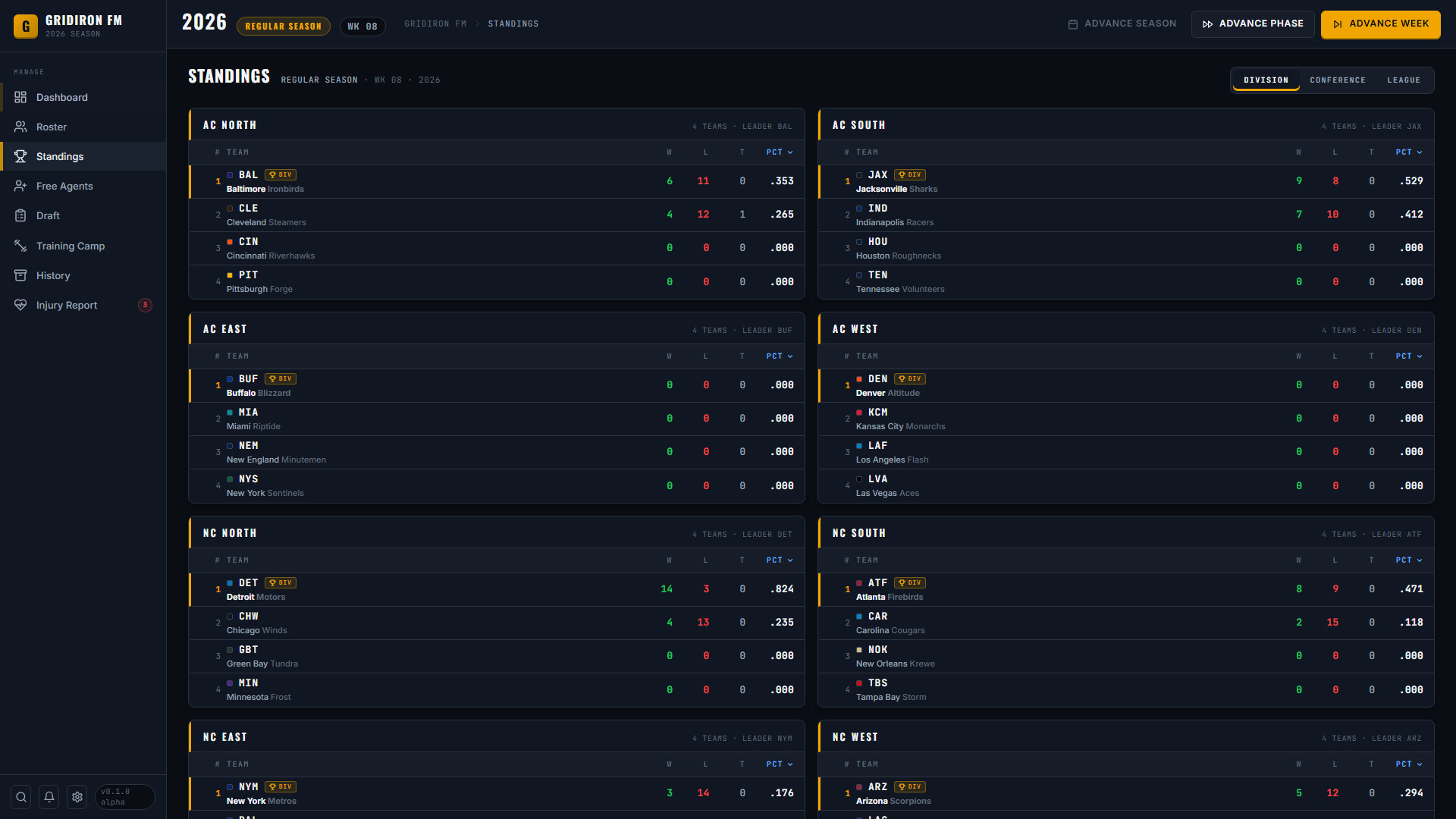
The pro league has two conferences with four divisions each. By default the season is 17 games, seven teams per conference make the playoffs, and the season ends in a championship game.
Pick any of the 32 teams at the start, from contenders that can win now to rebuilds that need time. Teams are rated by the starters you would inherit.
When you start a new league, you can change league rules like season length, roster size, the number of playoff teams and overtime, or switch the college league off.
You also choose whether the record book starts with the real-world records, held by invented players, or starts blank. The records a player holds show on his career page.
By default, every veteran comes with a generated history of earlier pro and college seasons, which counts toward his career totals.
Play one week at a time, or sim to the playoffs, through the championship game or on to next season.
The offseason runs one phase at a time: retirements, re-signing and tags, free agency, the draft, undrafted free agents and the final cuts.
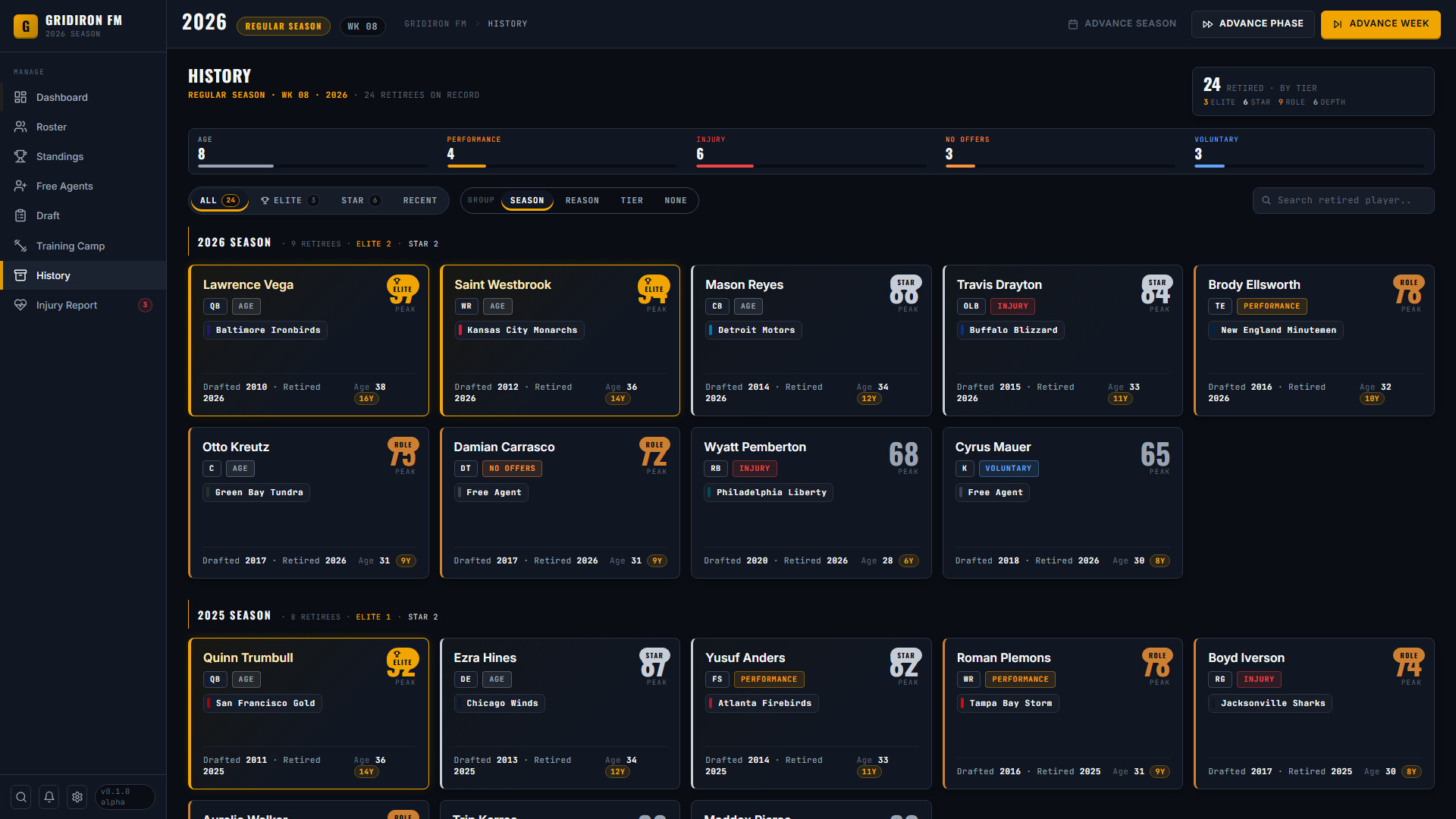
Players develop week by week and year by year, then peak, decline and retire.
Planned during Early Access
None of this is in the game yet. The list is roughly in the planned order, and the order and the details can change with player feedback.
Deeper stats: game-by-game stat logs for pro players, expected points added, longest runs and catches, and team stat ranks.
League stats tuned to land close to recent real pro and college seasons.
Your own scouting staff: scouts, a big board you rank yourself from their reports, pre-draft workouts and mock drafts, with computer teams drafting from their own boards.
Staff and job security: hiring coordinators, goals set by the owner, and the chance of being fired.
League news: a weekly news feed, pro power rankings based on results, and pro season awards with award races.
A bigger library of plays to fill your playbook from, routes shown on the field during each play, and opponent scouting.
Player morale, holdouts and a weekly inbox.
Press conferences, locker-room friendships and feuds, fan mood, and optional crowd sound.
League history: champions, a Hall of Fame, a records screen, franchise pages and stat finders.
Before the full release: a guide for new players, a glossary, more in-game help, basic accessibility options, and editors for building and sharing your own league and rule files.
Good to know
The league, teams, college programs, players, awards and record holders are fictional. The real-world record figures in the optional record book haven't been checked against a source yet.
There is no sound or music, and no 3D: much of the game is reading tables, reports and play-by-play.
League stats aren't tuned yet. Pro teams run too few plays, convert too many third downs and punt too rarely. The Early Access notes above list more gaps.
Computer teams draft from prospects' true ratings, not from the grade ranges you see.
Setting up a new league takes a long time, longer on PCs with fewer CPU cores, because its history is simulated first. A progress bar shows how far along it is, and choosing fewer warm-up seasons starts you sooner, though your first draft classes then have shorter college careers.
Plays offline, with no microtransactions. English only, mouse and keyboard.
体験版と発売について
現在の確認データでは体験版の存在を確認できていません。過去にも体験版がなかったという意味ではありません。最新の提供状況はSteamのゲームページで確認してください。
情報・画像:Steam · 最終確認 UTC